Commercial EV Charging Infrastructure Planning Guide: Engineering Design, Capacity Modeling and Procurement Framework
Jun 29,2026
Blog
Sizing a bank of fast chargers from nameplate totals alone can overload a site transformer during a concentrated fleet recovery window and delay departures. The cause is a coincidence and capacity-modeling problem—not simply a defective charger. The design should separate arrival cohorts, add managed charging, and reserve switchgear space for growth.
commercial EV charging infrastructure planning starts with route, dwell-time, and energy data; it then verifies utility capacity, selects an AC/DC architecture, and tests interoperability. For a 20-van fleet, 1,200 kWh needed over an eight-hour window equates to 150 kW average energy delivery; allowing 90% charging efficiency and a 25% design margin produces about 209 kW of input capacity before local code and utility rules are checked. Verify the resulting input capacity against the actual load profile, local code, and utility rules. Freeze the load profile and utility assumptions before issuing a purchase order.
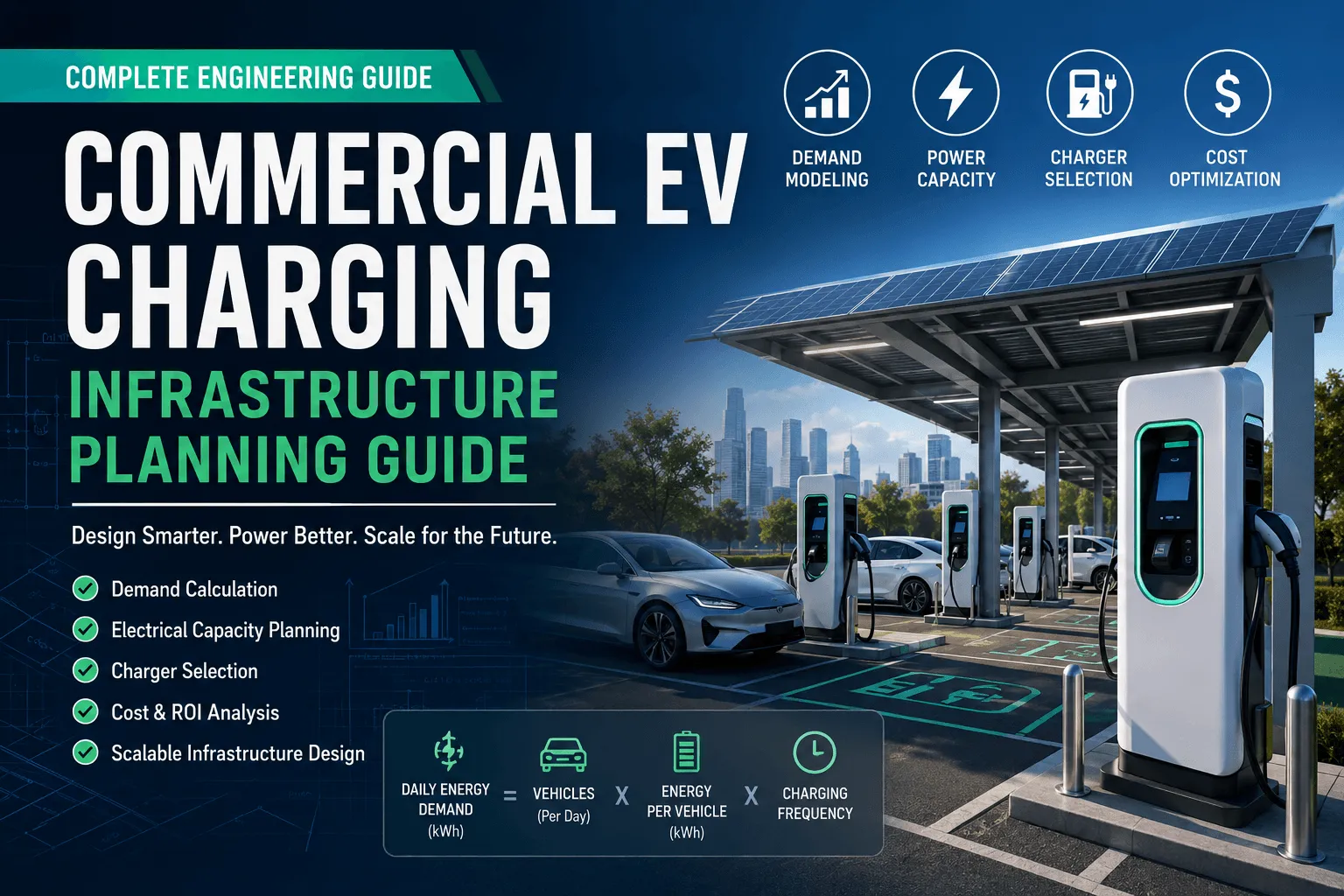
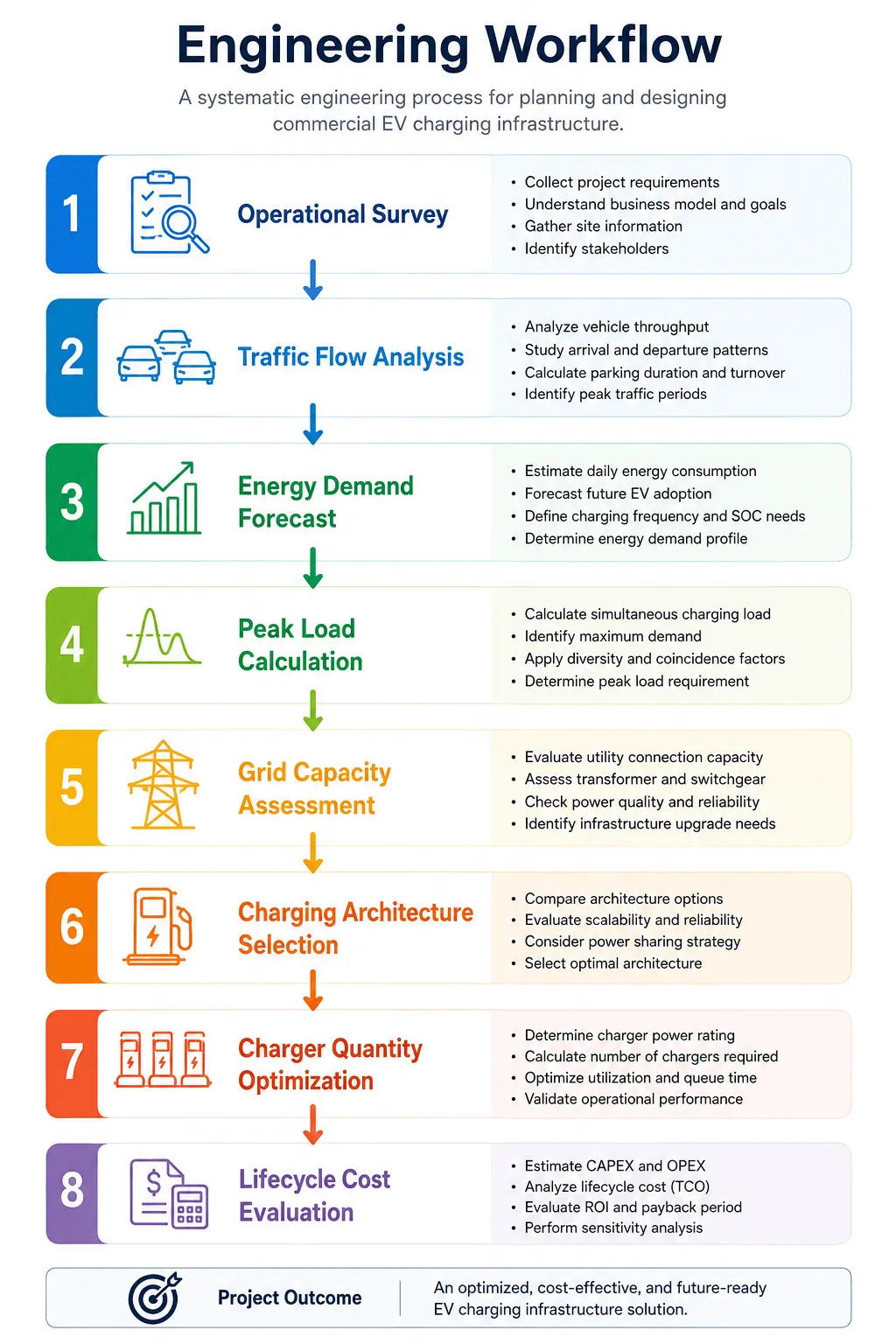
Commercial EV charging infrastructure is a long-term engineering investment rather than a standalone equipment purchase. Successful projects begin with operational demand forecasting, electrical infrastructure assessment, charging architecture selection, capacity modeling, interoperability planning, lifecycle cost analysis and supplier evaluation. This guide provides a structured engineering framework that enables project owners, fleet operators, commercial property developers and procurement teams to make technically sound and financially sustainable decisions.
What demand must the charging site serve?
Determine charging demand using operational data, traffic flow and energy consumption models before selecting charger types or power ratings.
Why must demand come before equipment selection?
Many commercial EV charging projects fail to achieve expected utilization or return on investment because infrastructure planning begins with equipment selection instead of demand analysis.
Charging demand directly influences:
Electrical infrastructure sizing
Charger quantity
Charger power rating
Transformer capacity
Capital investment
Lifecycle operating cost
Future expansion capability
Demand analysis should therefore become the first engineering task in every commercial charging project.
Which engineering principles keep the design scalable?
Commercial charging infrastructure should follow five fundamental engineering principles.
Demand-Driven Design
Charging capacity must be determined by operational demand rather than equipment availability.
Peak Demand First
Electrical systems should be designed for peak charging demand instead of average daily consumption.
Infrastructure Before Equipment
Grid capacity and electrical infrastructure define charger selection—not the reverse.
Modular Expansion
Electrical distribution systems should reserve sufficient capacity for phased expansion over the next 5–10 years.
Lifecycle Optimization
Engineering decisions should minimize total lifecycle cost instead of initial procurement cost.
Which business scenario is the site serving?
Before calculating charging demand, project planners should first identify the operational scenario because different business models produce fundamentally different charging behaviors, utilization rates and investment objectives.
Category
Typical Applications
Engineering Considerations
Fleet Charging
Logistics, delivery, municipal fleets
High daily utilization, predictable charging windows
Destination Charging
Hotels, resorts, tourist attractions
Long parking duration, lower charging power
Workplace Charging
Office buildings, business parks
Employee charging, daytime load management
Public Charging Network
Urban charging hubs
High vehicle turnover, dynamic utilization
Retail Charging
Shopping centers, supermarkets
Short dwell time, mixed AC/DC deployment
Bus Depot Charging
Public transportation
High-capacity DC charging, overnight scheduling
Logistics Hub Charging
Distribution centers
Continuous operation, fleet optimization
Selecting the wrong business scenario often results in oversized infrastructure or insufficient charging capacity.
How do site applications change the charging architecture?
Application
Observed operating pattern
Architecture to evaluate
Evidence to collect
Urban fleet depot
Predictable returns; tight departure wave
Managed DC charging or mixed AC/DC
Route energy, queue tolerance, overnight window
Bus depot
High daily kWh; fixed blocks and layovers
High-power DC with pantograph or plug options as applicable
Traffic counts, tariff model, accessibility and queue plan
Which vehicle characteristics set charging power?
Vehicle type determines charging duration, battery capacity and charger power requirements.
Vehicle Type
Typical Battery Capacity
Recommended Charging Power
Passenger EV
50–90 kWh
7–22 kW AC / 60–120 kW DC
Commercial Van
70–120 kWh
60–180 kW DC
Light Truck
100–200 kWh
120–240 kW DC
Heavy-duty Truck
300–600 kWh
350 kW+
Electric Bus
250–500 kWh
240–480 kW DC
Vehicle mix is one of the most important inputs when determining charger quantity and charging architecture.
Which operating data should the model use?
Operational data forms the foundation of engineering calculations.
Parameter
Why It Matters
Vehicle Throughput
Determines charger demand
Arrival Rate
Predicts queue formation
Departure Rate
Defines charging window
Parking Duration
Determines AC or DC charging suitability
Charging Frequency
Influences daily energy demand
Vehicle Turnover
Measures infrastructure utilization
Queue Length
Indicates service performance
Simultaneous Charging Ratio
Determines peak electrical load
Charger Utilization Rate
Influences ROI
Instead of asking “How many chargers should I buy?”, engineers should first ask “How many vehicles require charging simultaneously?”
How can engineers build an auditable decision workflow?
Define the service promise. Record vehicles per shift, minimum state of charge at departure, arrival/departure distributions, dwell time, weather assumptions, and acceptable queue time. Fleet telematics and interval-meter data are preferable to anecdotal peak counts.
Build two demand cases. Model a normal day and a stressed case (for example, late arrivals, cold weather, or a special event). Report daily kWh, coincident kW, sessions per connector, and the hours when demand occurs.
Check the electrical constraints. Obtain the utility service limit, transformer nameplate and loading history, fault-current data, protection settings, spare breaker positions, cable routes, and metering requirements. Ask the utility in writing what upgrade lead time and export restrictions apply.
Choose architecture against dwell time. Long parking windows usually favor distributed AC; constrained turnaround or high-energy vehicles may justify DC. Compare a centralized power cabinet, distributed dispensers, or a hybrid arrangement for maintainability and expansion.
Validate controls and operations. Define who can curtail load, how failed sessions are escalated, which backend owns the data, and how firmware and cybersecurity updates are governed. Require an acceptance test that reproduces the agreed load and communications scenarios.
How should energy demand be translated into electrical capacity?
Energy demand determines electrical infrastructure requirements.
Engineering Parameter
Application
Battery Capacity
Daily energy demand
State of Charge (SOC)
Charging duration estimation
Daily Energy Consumption
Grid capacity planning
Peak Charging Demand
Transformer sizing
Charging Window
Load scheduling
Maximum Demand
Utility connection
Demand Diversity Factor
Load optimization
Coincidence Factor
Infrastructure utilization
Power Factor
Electrical system efficiency
Energy demand modeling is the basis for transformer sizing, switchgear selection and feeder design.
How should engineers model charging capacity?
Assume 20 vans each require 60 kWh per operating day and must be ready within an eight-hour overnight window. Daily energy is 20 × 60 = 1,200 kWh. Average delivered power is 1,200 ÷ 8 = 150 kW. Using a 90% planning assumption for end-to-end charging efficiency, input power is 150 ÷ 0.90 ≈ 167 kW. Applying a 1.25 planning margin gives 167 × 1.25 ≈ 209 kW. A designer could evaluate a 240 kW connection or a lower connection with managed EV charging, but the final choice depends on utility studies, local electrical code, harmonics, ambient temperature, and the vehicles’ actual charge-acceptance curves.
Do not multiply every connector’s nameplate rating and call that the service requirement. Use a coincidence or diversity assumption that is supported by the operating schedule, then test the worst credible interval. Good EV charging capacity planning should also show a five-year expansion case, spare conduit, and the point at which a second transformer or service upgrade becomes necessary.
Which financial inputs change the engineering choice?
Issue a data sheet defining connector type, voltage range, current limits, ambient conditions, ingress/impact requirements, cable reach, and accessibility—not just kW.
Request efficiency curves, standby consumption, acoustic limits, derating behavior, maintenance intervals, spare-parts availability, and a warranty process. Reject unsupported “maximum uptime” claims unless the measurement method and exclusions are stated.
Specify OCPP version and conformance evidence, cybersecurity responsibilities, remote diagnostics, firmware rollback, time synchronization, and exportable transaction data. OCPP is a protocol; it is not a blanket safety certification.
Require drawings for foundations, bollards, ventilation, fire separation, drainage, cable trenching, switchgear, and metering. Confirm who obtains permits and who pays for utility upgrades.
Set factory and site acceptance tests: insulation/protective-conductor checks, emergency-stop behavior, residual-current protection where applicable, communications loss, payment authorization, load sharing, and vehicle interoperability.
Score bids on five-year total cost of ownership: civil works, demand charges, energy losses, network fees, planned service, downtime response, and expansion cost. Use the EV charger procurement guide as a supplementary commercial checklist, then verify every requirement against the project’s jurisdiction.
Which site constraints determine project feasibility?
Physical site conditions frequently determine project feasibility more than equipment specifications.
Power Supply & Electrical Infrastructure
This section determines the amount of power that can be brought to the site and how that energy is distributed:
Grid Capacity: The maximum available capacity the upstream grid can supply to the site. This is often the primary bottleneck for constructing high-power fast-charging stations.
Transformer Capacity: The capacity of existing on-site transformers—or the potential for capacity expansion—directly determines how many units can operate simultaneously.
Switchgear (High/Low Voltage Distribution Cabinets): Critical equipment for controlling, protecting, and isolating the power system; its physical space and current ratings limit the addition of new circuits.
Distribution Panel: The terminal power distribution unit; it is necessary to assess whether there are sufficient spare circuit slots (breaker spaces) and adequate load-bearing capacity.
Cable Routing: The path taken by cables from the power distribution room to the terminal equipment. Factors such as soil conditions, existing underground utilities, and paved surfaces affect route length and construction complexity, directly impacting costs.
Space, Land & Physical Layout
Available Land: The actual usable net area of the site where equipment, transformers, and auxiliary facilities can be legally installed.
Parking Layout: For EV projects, parking space design (perpendicular, angled, or heavy-vehicle bays) and dimensions must ensure smooth vehicle entry and allow charging cables to easily reach the vehicle’s charging port.
Safety, Environment & Utilities
Auxiliary support conditions required to ensure long-term, stable system operation and regulatory compliance:
Communication Network: The availability of on-site cellular signals (4G/5G) or wired broadband coverage. This is crucial for equipment connectivity, backend management (e.g., OCPP communication), and payment processing.
Cooling Requirements: High-power, high-voltage equipment (such as superchargers and transformers) generates significant heat during operation; the site must provide adequate ventilation or sufficient space for specialized chilled-water or air-cooling units. Fire Protection: Compliance with local fire safety regulations (e.g., fire separation distances, provision of fire-extinguishing equipment, and safe evacuation routes), particularly mandatory fire safety requirements for high-voltage and battery-related facilities.
Drainage: Drainage capacity for outdoor sites or underground garages. Measures must be in place to prevent accumulated rainwater from submerging the bases of electrical equipment, thereby ensuring electrical safety.
Which failure modes should acceptance tests cover?
Failure mode
Early warning
Control or acceptance test
Transformer overload
High coincident kW; nuisance trips
Interval-meter baseline, staged energization, load-shed test
Connector or cable mismatch
Vehicle rejects sessions; adapters used informally
Verify regional connector requirements and test representative vehicles
Network outage
Heartbeat gaps or offline transactions
Document fallback authorization, local queuing, and recovery reconciliation
Water, heat, or impact exposure
Standing water, derating, blocked bollards
Drainage, ingress/environmental ratings, clearances, and inspection plan
Vendor lock-in
Closed APIs or paid data export
Contract for documented interfaces, data ownership, and exit testing
Which standards and interfaces must work together?
Charging Interface & Connector Standards
This section covers the mainstream physical charging interfaces (connectors) and electrical characteristic standards across different global regions:
CCS1 (Combined Charging System 1): The mainstream DC fast-charging standard in the North American market, based on the AC Type 1 (SAE J1772) interface.
CCS2 (Combined Charging System 2): The mainstream DC fast-charging standard in Europe and most other regions, based on the AC Type 2 (Mennekes) interface.
NACS (North American Charging Standard): A charging standard for North America (originally Tesla’s proprietary interface); it has now been standardized by SAE as J3400 and has become the dominant standard in the North American market.
GB/T (Chinese National Standard): The EV charging standard for the Chinese market (covering AC GB/T 20234.2 and DC GB/T 20234.3; currently evolving toward the next-generation ChaoJi standard).
SAE J1772: The North American standard for single-phase AC charging interfaces (Type 1), widely used for residential slow-charging stations.
Basic Electrical & Safety Standards
IEC 61851: The overarching standard for EV conductive charging systems, defining charging modes (Modes 1–4), safety requirements, and basic control pilot signals (PWM).
IEC 62196: Specifies dimensional interchangeability and performance requirements for charging plugs, socket-outlets, vehicle inlets, and vehicle connectors (defining the underlying specifications for the physical interfaces mentioned above).
Advanced Communication & Roaming Protocols
ISO 15118: The communication protocol between the vehicle and the charging station (V2G / vehicle-to-charger communication). It supports advanced features such as Plug & Charge, smart charging management, and bidirectional charging (V2G).
OCPP 2.0.1 (Open Charge Point Protocol): An open communication protocol between charging stations and a central management system (cloud backend). Version 2.0.1 brings significant enhancements to security, device management, and support for ISO 15118.
OCPI (Open Charge Point Interface): A roaming protocol between Charging Point Operators (CPOs) and e-Mobility Service Providers (eMSPs) that enables EV users to charge and settle payments across different charging networks.
Design implication: Designing projects and developing products based on EV charging open standards (such as OCPP, ISO 15118, etc.) effectively reduces reliance on specific vendors (avoiding vendor lock-in) and greatly simplifies future system upgrades, capacity expansion, and cross-platform interoperability.
Which official standards and references should be verified?
Apply the edition adopted in the destination market and by the authority having jurisdiction. IEC 61851 covers conductive charging-system modes and control; IEC 62196 addresses plugs, socket-outlets, vehicle connectors, and inlets. ISO 15118 specifies vehicle-to-grid communication functions, while OCPP 2.0.1 is an Open Charge Alliance communications protocol between charge points and a central system. In North America, connector and installation requirements may also involve SAE J1772/J3400 and the National Electrical Code (NFPA 70); confirm the locally adopted edition rather than treating a protocol as a permit.
Which charging architecture fits each application?
Scenario
Recommended Architecture
Design Priority
Logistics Fleet
Centralized DC Charging
Fleet turnaround
Bus Depot
High-power DC Charging
Overnight charging
Office Building
AC Charging
Employee convenience
Hotel
Destination AC Charging
Long dwell time
Shopping Mall
AC + DC Hybrid
Customer experience
Public Charging Hub
Distributed Fast Charging
Maximum utilization
Which planning mistakes cause overload, waste, or lock-in?
Selecting charger power before completing demand analysis.
Ignoring simultaneous charging during peak operating hours.
Underestimating transformer loading.
Designing only for current demand without reserving expansion capacity.
Overestimating charger utilization without traffic modeling.
Ignoring demand charges in lifecycle cost calculations.
Selecting proprietary communication protocols that limit future interoperability.
What should be verified before design freeze?
✅ Define charging business model
✅ Analyze vehicle mix and traffic flow
✅ Calculate daily and peak energy demand
✅ Verify transformer and grid capacity
✅ Select charging architecture
✅ Validate interoperability standards
✅ Model lifecycle cost and ROI
✅ Reserve capacity for future expansion
What should the project team carry forward?
Commercial EV charging demand analysis is not simply a calculation of charger quantity. It is the engineering foundation that determines electrical infrastructure design, charging architecture, capital investment, operational efficiency and long-term scalability. Projects that prioritize operational analysis before equipment selection consistently achieve higher charger utilization, lower lifecycle costs and greater flexibility as EV adoption grows.
Frequently asked questions
Why should demand analysis be conducted before selecting charging equipment?
Many projects fail because they start with equipment selection rather than operational data analysis. Charging demand (derived from vehicle throughput, arrival rates, and parking duration) directly dictates critical infrastructure sizing, including charger quantity, power ratings, transformer capacity, and initial CAPEX. Prioritizing demand analysis ensures higher charger utilization and avoids costly oversized or under-capacity installations.
What are the risks of ignoring “Simultaneous Charging Ratio” during peak hours?
Designing electrical systems based on average daily consumption rather than peak demand is a common engineering mistake. Ignoring the simultaneous charging ratio during peak hours usually leads to severe transformer overloading, tripped switchgear, or localized grid failure. Engineers must ask “How many vehicles require charging simultaneously?” to accurately size transformers and design load-scheduling strategies.
How do site constraints like “Grid Capacity” act as a bottleneck for commercial charging projects?
Physical site conditions frequently determine project feasibility more than equipment. Grid capacity—the maximum available power specifications the upstream grid can supply—is often the primary bottleneck for high-power fast-charging stations. If the existing grid or transformer capacity is insufficient and cannot be expanded, the project cannot support advanced DC fast chargers regardless of the equipment specifications.
Why is a “Modular Expansion” approach recommended for electrical distribution design?
EV adoption scales over time. Designing infrastructure only for current demand without reserving expansion capacity is a critical mistake. Electrical distribution systems should follow the “Infrastructure Before Equipment” principle, reserving sufficient space and capacity (such as spare breaker spaces in distribution panels) for phased, seamless expansion over the next 5–10 years.
What is the significance of adopting open standards like OCPP 2.0.1 and ISO 15118?
Selecting proprietary communication protocols limits future interoperability and leads to vendor lock-in. Designing around open standards ensures compatibility between vehicles, chargers, and cloud networks. Specifically, ISO 15118 enables advanced features like Plug & Charge and bidirectional charging (V2G), while OCPP 2.0.1 enhances security and backend device management, greatly simplifying future system upgrades.
How should charging architectures be matched to different business scenarios?
Planners must match the architecture to the parking behavior of the scenario. For instance, Logistics Fleets and Bus Depots require Centralized/High-power DC Charging to ensure fast vehicle turnaround or overnight scheduling. Conversely, Office Buildings and Hotels should deploy AC Charging because employees and guests have long parking durations (dwell times), making daytime load management more practical and cost-effective.
Why must “Demand Charges” be included in lifecycle cost calculations?
Engineering decisions should minimize the EV charging total lifecycle cost (LCO) instead of initial procurement cost (CAPEX). Relying solely on equipment cost and simple energy consumption while ignoring utility demand charges—tariffs based on peak power draw—leads to severely warped ROI models. Factoring in demand charges allows engineers to implement peak-shaving and load-optimization strategies to minimize operational expenses (OPEX).
What auxiliary site systems are critical for maintaining safety and compliance?
Beyond the chargers themselves, three auxiliary systems are critical:
Fire Protection: Compliance with local fire safety distances and mandatory mitigation for high-voltage and battery systems.
Cooling Requirements: Ensuring adequate ventilation or space for chilled-water units to handle the massive heat generated by superchargers.
Drainage: Proper drainage capacity in outdoor or underground sites to prevent accumulated rainwater from submerging electrical equipment bases, supporting electrical safety.
How much electrical capacity does a commercial charging site need?
There is no universal number. Calculate coincident kW from the vehicle schedule, charging efficiency, diversity, and a documented design margin; then validate the result with the utility and the authority having jurisdiction. Include a normal case, stressed case, and expansion case.
Is a 240 kW charger suitable for every fleet?
No. Vehicle charge-acceptance limits, dwell time, service capacity, and queue behavior determine suitability. A 240 kW unit may be useful for short-turnaround operations, while managed AC can be more economical for overnight parking; compare both against measured duty cycles.
What should an EV charging tender include besides charger power?
Specify connectors, electrical environment, thermal derating, safety functions, networking, data ownership, service response, civil works, acceptance tests, and expansion provisions. Ask bidders to identify assumptions and exclusions so proposals can be compared on total cost rather than headline kW.
How can a site keep charging during an internet outage?
Define an offline authorization and transaction-queue policy, local safety controls, and a reconciliation process after connectivity returns. Test the policy with the selected backend and payment method; behavior varies by implementation and market rules.
Do IEC, ISO, or OCPP references prove product certification?
No. IEC and ISO documents can define requirements or communication functions, and OCPP defines an open protocol. Request the specific accredited test report, listing, or declaration required by the destination market, and check its scope and expiry.
What should project teams do next?
Use an evidence trail from route data to utility approval, then from factory test to site acceptance. XYDF can be considered alongside other suppliers when its documented configuration, testing records, and support model fit the project; review the commercial EV charging solution overview and any relevant 240 kW DC fast-charger information without assuming unverified specifications. For a project-specific review of a commercial EV charging station, contact the team with the load profile, site constraints, connector market, and expansion plan. The durable principle is simple: size the service for the operation you can prove, and procure the equipment you can test.
We use cookies to keep this website working and, with your permission, to measure how visitors use our EV charging site. See our Privacy Policy for details.
 Xinya Dongfang Electricity Technology Co., Ltd.