How to Plan a 22kW AC Charger Deployment for Commercial Parking
Oct 06,2026
Blog
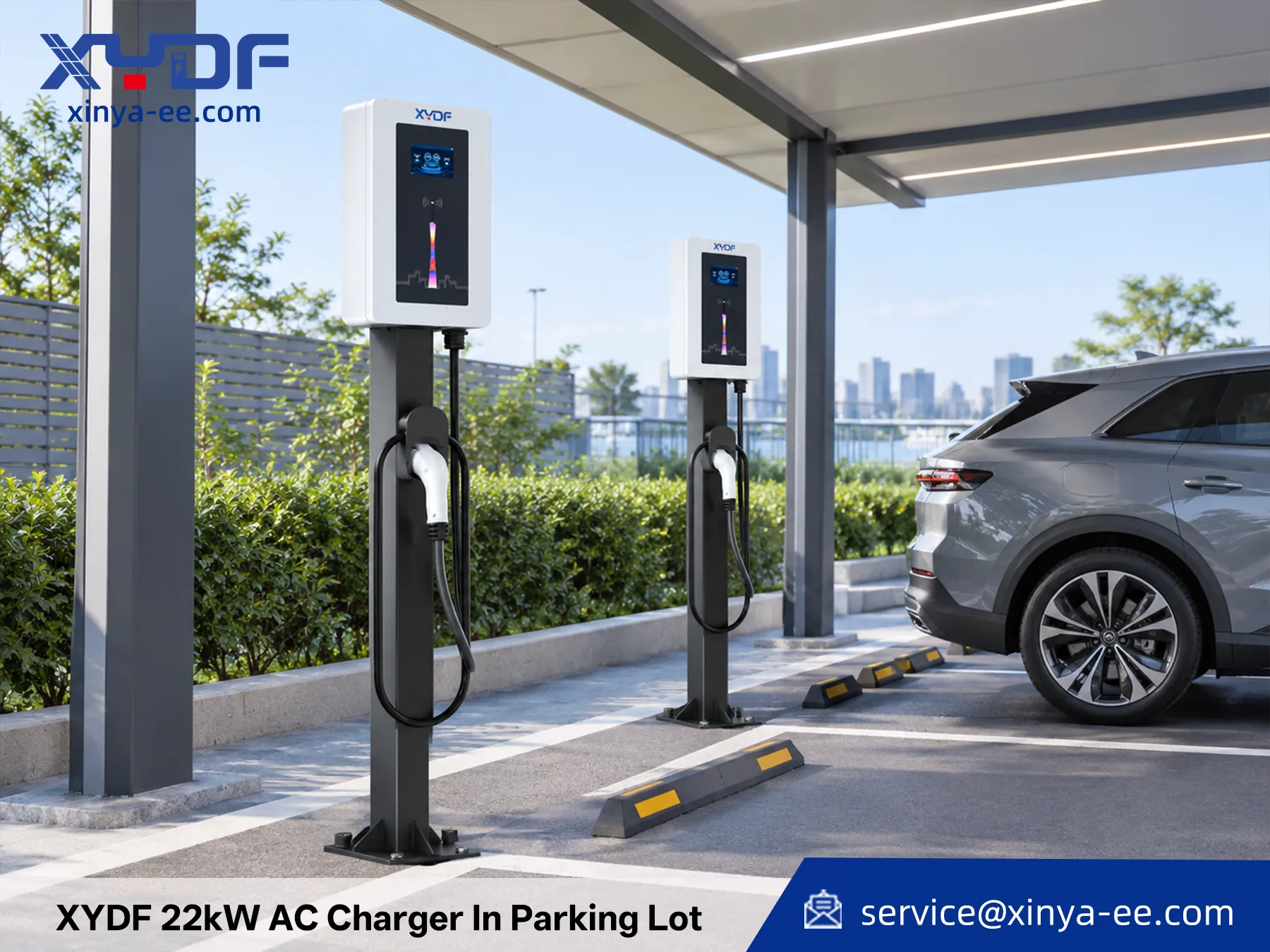
For commercial parking facilities, planning a Cargador AC de 22 kW deployment requires more than simply counting EVs. Parking duration, EV charging demand, charging-space layout, and future expansion all need to be considered.
The goal is to match charging infrastructure with actual parking and charging behavior rather than installing chargers based solely on the number of EVs.
Tabla de Contenidos
1. Why Are 22kW AC Chargers Suitable for Commercial Parking?
Vehicles in commercial parking facilities often stay for several hours. Hotels, office buildings, and commercial complexes can all make use of parking time for EV charging.
Therefore, the focus when planning a Cargador AC de 22 kW deployment is not to charge every EV as quickly as possible, but to provide an appropriate number of charging spaces based on parking duration and actual charging demand.
2. How Many EV Charging Spaces Does a Commercial Parking Facility Need?
When planning charging infrastructure, start with the size of the parking facility and the expected EV parking demand.
For example, suppose a commercial parking facility has 100 spaces. If 20% of vehicles are assumed to be EVs, the potential EV parking demand would be around 20 vehicles. This does not mean that 20 charging spaces are required.
Several factors should also be considered:
Not every EV needs to charge every day.
Parking duration and charging needs vary between vehicles.
Some vehicles may have already charged elsewhere.
One charging space can serve multiple EVs at different times.
An EV parking ratio can therefore be used as an initial planning reference, with the actual deployment adjusted based on charging utilization.
Parking Spaces
Example EV Share
Potential EV Parking Demand
50
20%
10
100
20%
20
200
20%
40
The 20% figure above is only an example to illustrate the planning method. It is not a universal industry standard for commercial parking facilities. Actual projects should consider parking data, local EV adoption, and user charging demand.
The more important question for a commercial parking facility is: How many parking spaces should have charging capability, rather than how many chargers are required for the total number of EVs?
3. How Does Parking Duration Affect 22kW AC Charger Deployment?
Parking duration is an important factor in determining how AC charging infrastructure will be used. When vehicles stay for only a short period, there is limited time for charging. When vehicles remain parked for longer, the parking period can be used for regular energy replenishment.
Parking Duration
Charging Consideration
Less than 1 hour
Limited charging opportunity
1–3 hours
Suitable for partial energy replenishment
3–6 hours
More charging time available
Overnight
Long charging window
For example, vehicles at a hotel may remain parked overnight, providing a long charging window.
For office buildings, planners should consider typical weekday parking duration as well as morning arrival and afternoon departure patterns. Parking duration at commercial complexes can vary considerably, so average parking time and vehicle turnover should be monitored.
As a result, two parking facilities with the same number of spaces may require very different charging infrastructure configurations.
4. Where Should 22kW AC Chargers Be Installed?
Once the number of charging spaces has been determined, the next step is to consider where those charging spaces should be located.
Prioritize Long-Stay Parking Areas
Hotels, office buildings, and similar sites can prioritize areas where vehicles typically remain parked for longer periods. This can improve charger utilization.
Consider the Location of Electrical Distribution
Charging-space locations should also be planned around the existing electrical infrastructure. Shorter cable runs can help reduce installation complexity.
Parking-space selection should therefore consider not only vehicle access, but also the available electrical distribution routes.
Make Charging Spaces Easy to Identify and Manage
Charging spaces should be clearly marked and separated from regular parking spaces. This can help reduce unauthorized parking by non-EVs and prevent vehicles from occupying charging spaces after charging is complete.
5. Does Every EV Parking Space Need a 22kW AC Charger?
Not necessarily. For small and medium-sized commercial parking facilities, part of the parking area can initially be equipped with charging spaces based on EV parking demand rather than covering every potential EV space.
Parking Area
Planning Approach
Hotel long-stay parking
Consider a higher proportion of charging spaces
Office employee parking
Base deployment on weekday utilization
Short-stay commercial parking
Keep the initial charging-space ratio controlled
Long-term public parking
Add charging spaces based on actual demand
The number of chargers therefore does not need to match the number of EV parking spaces. The initial charging-space coverage should be determined by actual parking and charging demand.
6. How Should Commercial Parking Facilities Prepare for Future Expansion?
EV charging demand may increase as EV adoption and user demand grow. Future expansion should therefore be considered during the initial planning stage.
Consider reserving:
Future charging spaces
Cable and conduit routes
Electrical capacity
Equipment installation space
Charging-space signage
Locations for additional 22kW AC Chargers
Commercial parking facilities can also adopt a phased deployment approach.
Phase 1: Initial Deployment
Install the initial charging spaces based on current EV demand.
Phase 2: Monitor Usage
Monitor charging-space utilization, peak charging periods, average parking duration, and changes in charging demand.
Phase 3: Expansion
Add charging spaces and 22kW AC charging equipment based on actual operating data.
This approach can help avoid overbuilding at the initial stage while leaving room for future growth in EV charging demand.
For commercial parking projects that require 22kW AC charging infrastructure, XYDF can provide AC charging solutions based on parking-facility size, vehicle usage patterns, installation conditions, and future expansion plans, with support for customized configurations and OEM/ODM cooperation.
Preguntas Frecuentes
Q: What electrical conditions should be considered when installing 22kW AC Chargers?
A: The project should evaluate the available three-phase power supply, electrical capacity, cable distance, and existing distribution system to determine whether it can support the additional charging load. The final solution should be based on the site’s actual electrical conditions.
Q: Can 22kW AC Chargers be installed outdoors?
A: Yes. The equipment should be selected according to the installation environment and applicable protection requirements, with factors such as rain, dust, temperature, and installation method taken into account.
Q: Do commercial parking facilities need to manage charging spaces separately?
A: Clear signage and parking-space management are recommended to prevent non-EVs from occupying charging spaces for extended periods. Charging-space usage can also be monitored through a parking or charging management system.
Conclusiones finales
For commercial parking facilities, planning a Cargador AC de 22 kW deployment is not simply about calculating how many chargers are needed for a given number of EVs. The key is to determine which parking spaces should provide charging capability and how the charging infrastructure should match actual parking behavior.
Starting with parking-space capacity, EV demand, and parking duration, then determining charging-space locations and initial coverage while preparing for future expansion can create a more flexible charging infrastructure that can grow with actual demand.
Fábrica de la sede en Zhejiang:
N.º 2, Calle Changjiang, Parque Industrial del Puente de Wenzhou, Ciudad de Beibaixiang, Ciudad de Yueqing, Ciudad de Wenzhou, Provincia de Zhejiang
Sucursal de Shenzhen:
1.er piso, Edificio A, Parque Industrial Shenkai, Comunidad Tangtou, Subdistrito Shiyan, Distrito de Bao'an, Shenzhen
Utilizamos cookies para que este sitio web funcione y, con su permiso, para medir cómo los visitantes utilizan nuestro sitio de carga de vehículos eléctricos. Consulte nuestra Política de Privacidad para más detalles.
 Xinya Dongfang Electricity Technology Co., Ltd.