EV Charger RMA Cost Breakdown: Chargers offered at discounts of up to 50 euros per piece have a catch. If the device later breaks, there is a risk of financial loss of over 1200 euros. When determining the actual total cost of a charger, you should not only look at the unit price ex-factory. Carefully consider all hidden costs, such as round-trip shipping, repair costs, costs for on-site electricians and even the complete loss of customers and future orders. Smart buyers should not be fooled by price traps in their purchasing decisions. Instead, pay close attention to the efficiency of RMA processing (returns and exchanges), the speed of customer service and most importantly, the actual failure rate.
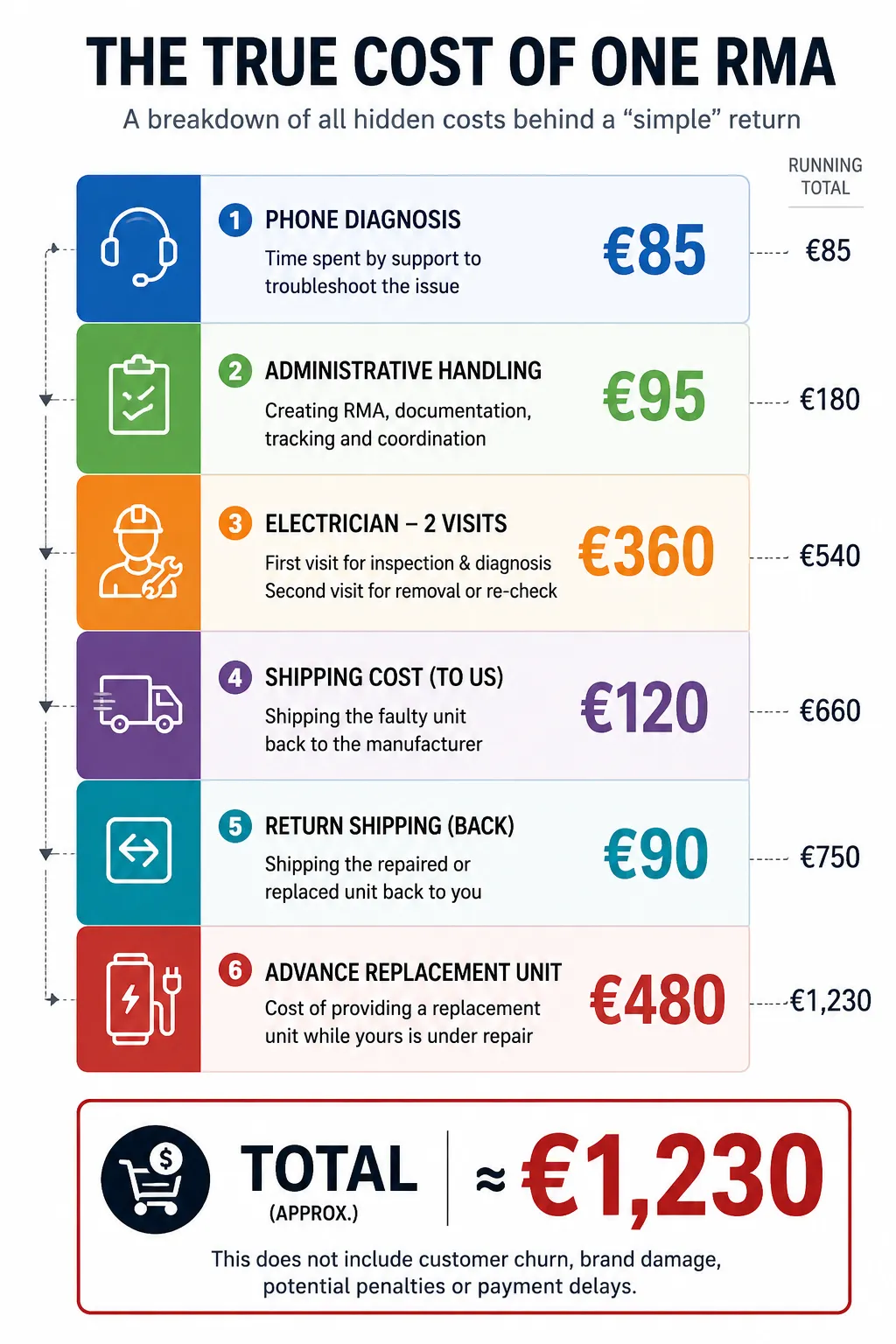
Let’s look at a concrete example of a charger failure A 22kW charger is installed in a German commercial establishment Eight months after Installation the contactor fails-a common weak point in cheap products The charger no longer works You get a call from the operations manager
First you spend 45 minutes on the phone to determine the cause The employee’s working time costs you about 85 euros Then you learn that photos, serial numbers and Installation documents are needed to get an RMA number from the manufacturer This means another 1 hour of paperwork
Then you send an electrician on the first visit he checks the device, on the second he builds the replacement parts The two visits cost 180 euros each, so a total of 360 euros Additionally you order a replacement device from the manufacturer Shipping, Customs and fees cost 120 euros Returning the defective device costs 90 euros Processing warranty claims is lengthy By now you have already paid for the new device: 480 euros in total, the cost of a single failure is around 1230 euros The potential loss of revenue for Website operators and the risk that they will never work with us again are not yet taken into account in the calculations
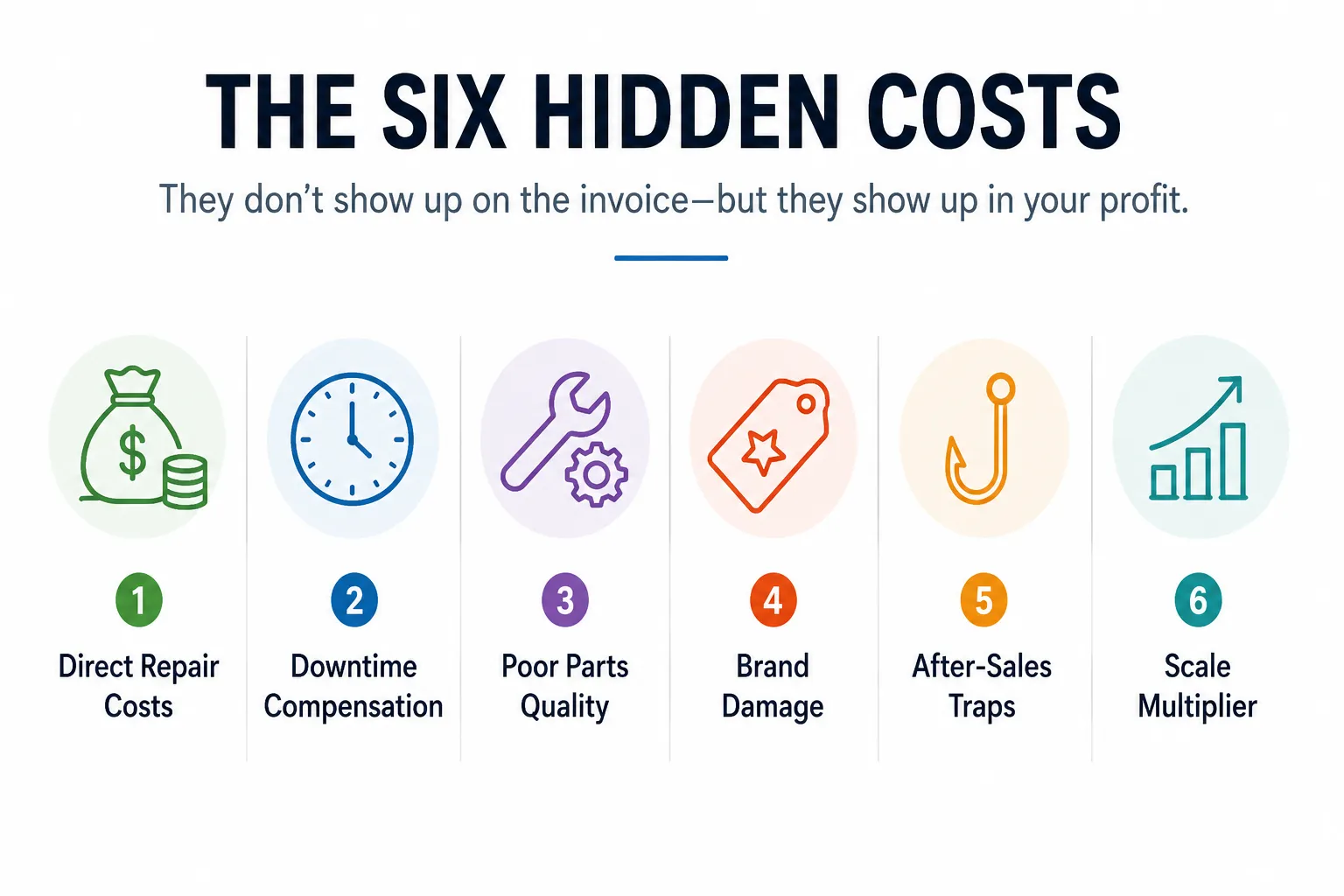
1.Direct replacement and logisticsEvery broken charger brings a stack of bills:
One failure eats €1,000–€1,500 of your profit. If you saved €60 per charger, you need 17 to 25 units to work perfectly just to break even on that one failure.
2.Downtime and customer compensation A charger that’s dead for two weeks isn’t just annoying. It costs the site owner money. Hotel guests complain. Office workers get frustrated. Apartment tenants ask for rent deductions. Some operators will bill you for lost charging revenue—€150 to €400 per incident. The bigger loss? They won’t come back to you for their next project.
3.Cheap parts break faster
4.Your brand takes the hit
Your customers don’t care who made the charger. They care that the one you sold them keeps breaking. One bad RMA loses a customer. Three bad ones ruin your reputation. In distribution, reputation is everything.
5.The “cheap hardware, expensive service” trap
Some factories play a game. They sell chargers at low margins, then make money on service. Their warranty is short. Exclusions are everywhere—lightning, surges, moisture, dust, “wrong installation.” Spare parts are proprietary. When they discontinue a model, parts prices go through the roof. You’re not buying a charger. You’re buying a long‑term service contract you can’t get out of.
6.Multiply it across hundreds of units
One failure at €1,200 is painful but manageable. Now imagine 500 units with a 10% failure rate—that’s normal for cheap hardware. That’s 50 RMAs a year. At €1,200 each, you’re spending €60,000 annually just on repairs. Add lost customers. Add lost future orders. Add the time your team spends fighting fires instead of selling.
The numbers just don’t work.
Red flags to watch for
Stop comparing unit prices. Start comparing total cost of ownership over 5–7 years.
True TCO = (unit price × qty) + (failure rate × RMA cost × qty) + lost customers + reputation damage
If you pay €100 more per unit and get a 2% failure rate instead of 10%, you save €8,000 per 500 units in RMA costs alone. And that doesn’t even count the customers you keep.
That extra €100 isn’t a cost. It’s an investment in your business.
Q: What’s a normal failure rate for commercial AC chargers?
A: Under 5% per year is good. Over 8%? That’s a red flag.
Q: How long should warranty be?
A: 3–5 years is standard for quality European brands. Just check the fine print—on‑site labor and environmental damage are often excluded.
Q: Does OCPP help reduce RMA costs?
A: Yes. OCPP‑compatible chargers let you diagnose and fix many issues remotely. That means fewer truck rolls and cheaper service overall.
 Xinya Dongfang Electricity Technology Co., Ltd.